
Merzouga Berber Camp: Culture, Hospitality and Authentic Desert Life
When you think of the Sahara Desert, what comes to mind? Perhaps endless golden dunes, star-filled nights, and camel treks across ancient trade routes. But the true magic of Merzouga lies not just in its stunning landscape—it's in the people who call this remote corner of southeastern Morocco home, and the warmth with which they welcome visitors into their world.
A Merzouga Berber camp offers something increasingly rare in our modern world: an opportunity to step away from the noise and disconnect from the digital world while genuinely connecting with a rich cultural heritage that has endured for centuries. This isn't tourism theater. It's an invitation to understand how the Berber people have thrived in one of Earth's most challenging environments, and to share in their traditions of hospitality, resilience, and joy.
In this guide, we'll explore what makes a Merzouga traditional camp experience so special, delve into the authentic Berber culture you'll encounter, and help you understand how to make the most of your desert adventure.
Understanding Merzouga and the Erg Chebbi Desert
The Gateway to the Sahara
Merzouga is a small village that sits at the edge of Erg Chebbi, one of Morocco's most spectacular sand dune formations. Located in the Tafilalt region near the Algerian border, Merzouga has long served as a gateway for those seeking authentic desert experiences. The village itself is modest—a collection of modest homes, a few shops, and increasingly, several desert camps that cater to visitors from around the world.
The real draw, though, is Erg Chebbi itself. These towering dunes, some reaching heights of 160 meters (over 500 feet), create an otherworldly landscape that shifts and changes with the light throughout the day. At sunrise, the dunes glow amber and crimson. By midday, they're a brilliant golden yellow. As sunset approaches, they turn deep orange and purple. By night, they transform into a canvas for one of the clearest starry skies you'll ever witness.
A Living Heritage
What distinguishes a Merzouga Berber camp from a generic desert resort is its connection to the actual communities that live here. The Berber people—who call themselves Amazigh, meaning "free people"—have inhabited North Africa for thousands of years. In the Sahara, the primary Berber groups include the Tuareg and the Arab-Berber communities who have settled in oases and around the dunes.
These communities aren't museum pieces. They're living, breathing cultures with their own languages, traditions, cuisine, and ways of understanding the world. When you stay at a Merzouga traditional camp, you're not watching Berber culture from behind glass—you're participating in it, learning from the people who've mastered survival and hospitality in one of the world's harshest environments.
The Essence of Berber Hospitality
A Culture of Welcome
One phrase that appears repeatedly in discussions of Berber culture is "Tagoundit"—which roughly translates to the sacred duty of hospitality. This isn't hospitality as a service industry transaction. It's a fundamental cultural value that runs deep in Berber society.
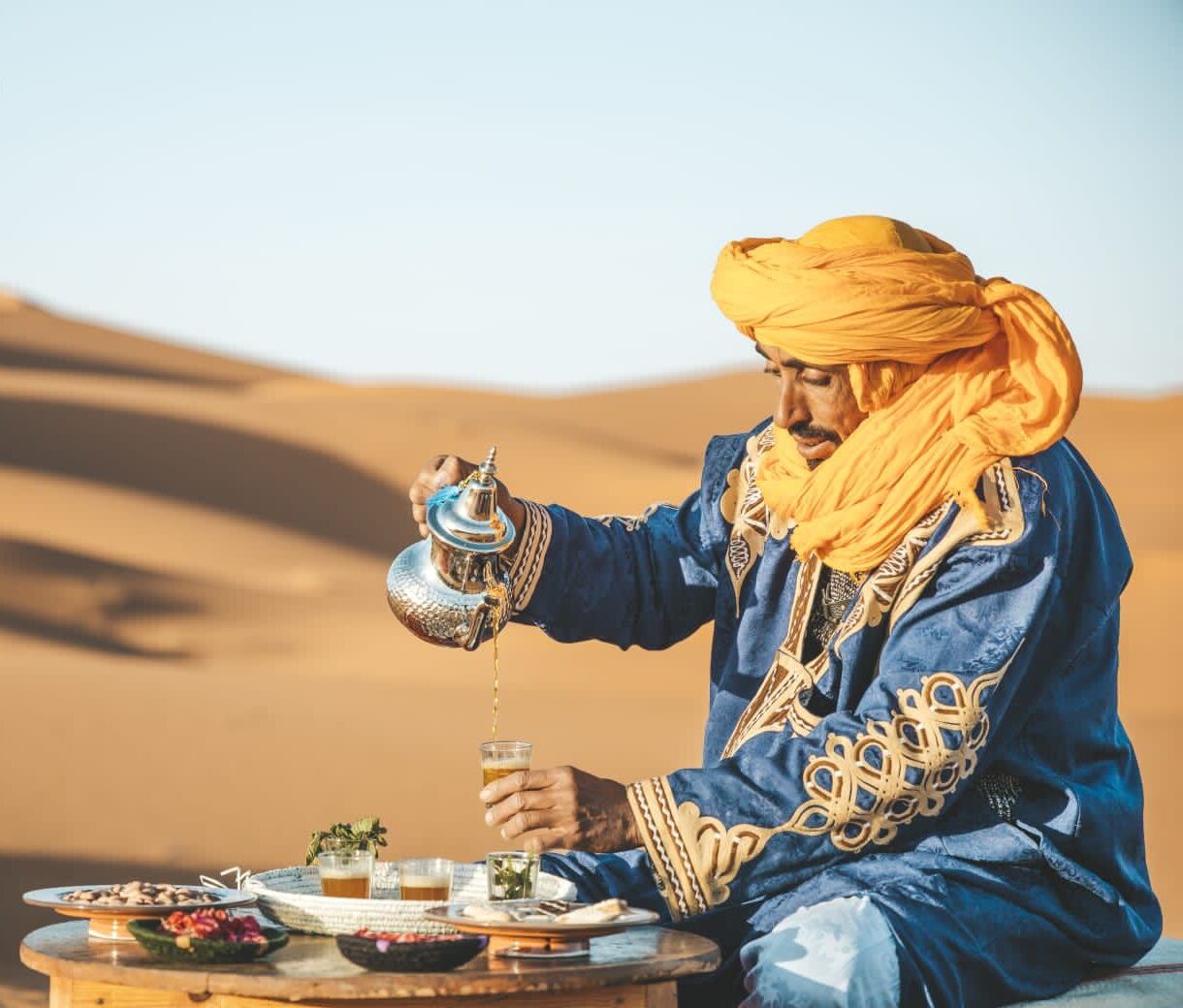
When you arrive at Original Desert Camp or any authentic Merzouga Berber camp, you'll immediately feel this philosophy in action. You'll be greeted with traditional Moroccan mint tea, offered comfortable seating, and made to feel genuinely welcome—not as a customer, but as a guest. This distinction matters. Guests are part of the community, at least temporarily. They're invited into homes, around evening fires, and into conversations.
The Berber people have a long history as traders and guides across the Sahara. For centuries, they've welcomed merchants, explorers, and travelers, understanding that hospitality builds relationships and trust—essential commodities in desert travel where mutual support could mean survival.
Tea, Food, and Connection
Central to Berber hospitality is the ritual of sharing food and drink. The preparation and serving of mint tea (atay) is more than a beverage service—it's a social practice, often involving multiple rounds with specific meanings. The first glass is strong and bitter (representing life's challenges), the second is smoother (representing the sweetness that follows hardship), and the third is light and delicate (representing the transience of life).
Meals in a Merzouga traditional camp typically feature tagine (a slow-cooked stew), fresh bread baked in communal ovens, vegetables, couscous, and sometimes lamb or chicken. These aren't fancy presentations designed for Instagram—they're genuine, hearty meals prepared using recipes passed down through generations. When you eat with your Berber hosts, you're partaking in their daily sustenance, the same food that's sustained their families for decades.
This shared eating experience breaks down barriers. Language becomes less of a obstacle when you're laughing over a delicious meal, using hand gestures, and genuinely enjoying each other's company.
Authentic Berber Culture in the Desert
Language and Identity
The Berber language, Tamazight (and its various dialects), predates Arabic in North Africa by thousands of years. While Arabic is the official language of Morocco, Tamazight remains the heartbeat of Berber identity. At a Merzouga Berber camp, you'll hear this language spoken daily, and many hosts enjoy teaching visitors basic phrases.
Learning to say "Azul" (hello), "Tanmirt" (thank you), or "Labas?" (how are you?) isn't just linguistically interesting—it's a gesture of respect toward your hosts' culture. It demonstrates genuine interest in understanding their world rather than simply consuming an experience.
Traditional Crafts and Skills
Berber people are renowned for their traditional crafts. Women create intricate carpets and textiles using techniques refined over centuries, with patterns that tell stories and hold symbolic meaning. Men work with leather, wood, and metal, crafting everything from decorative items to functional tools.
At many Merzouga Berber camps, including Original Desert Camp, visitors have opportunities to watch these craftspeople at work, ask questions, and often purchase directly from artisans—ensuring that your money supports the actual creators rather than middlemen. You might see a woman weaving a carpet at sunset, or watch a craftsman create a leather pouch with the same techniques his father and grandfather used.
Music and Celebration
Music holds profound significance in Berber culture. Traditional instruments like the bendir (frame drum), the oud (stringed instrument), and the lotar create hypnotic rhythms and melodies. In the evenings at a Merzouga traditional camp, you might be treated to live music and even encouraged to join in dancing or drumming.
These musical traditions often accompany celebrations, storytelling, and spiritual practices. A wedding celebration (if you're fortunate enough to witness one during your visit) might involve days of music, dancing, and feasting. Even casual evening gatherings around the fire can include impromptu musical performances.
The Desert Experience: Beyond the Stereotypes
Camel Trekking Through Erg Chebbi
One of the primary reasons visitors come to a Merzouga Berber camp is to experience camel trekking. This isn't a theme park ride—it's a genuine mode of transportation that's been used in the Sahara for centuries. The Dromedary camel (with one hump, as opposed to the Bactrian with two) is perfectly adapted to desert life, capable of traveling long distances on minimal water.
When you trek through Erg Chebbi at sunrise or sunset, riding a camel that your guide knows personally, you'll understand why these animals are called "ships of the desert." There's something profoundly moving about moving slowly across ancient dunes, silence surrounding you except for the soft padding of camel feet on sand, watching the landscape transform with the changing light.
A quality Merzouga Berber camp ensures that camels are well-treated, properly hydrated, and not overworked. The guides leading these treks are typically Berber men with deep knowledge of the desert—they can read weather signs, know the safest routes, and understand camel behavior intimately.
Sleeping Under the Stars
Most Merzouga traditional camps offer accommodation in traditional Berber tents (often called "bivouacs" or "zeniths"). These are not the cramped camping tents many Western visitors imagine. Authentic Berber tents are spacious, with high ceilings to allow heat to rise away from sleeping areas, and are typically furnished with carpets, cushions, and comfortable bedding.
The night sky above Erg Chebbi is one of the clearest on Earth. Away from light pollution, you'll see thousands of stars—the Milky Way so bright and distinct that it casts shadows. Many camps, including Original Desert Camp, encourage guests to spend time simply lying under the stars, contemplating the vastness of the universe. Some offer telescope viewings or guides who can point out constellations and share how ancient peoples used the stars for navigation.
This experience has a way of shifting perspective. The concerns that seemed so pressing in your daily life suddenly feel very small under the infinite sky. It's a humbling, often spiritual experience that many visitors describe as transformative.
Desert Sunrise and Sunset
The play of light across Erg Chebbi's dunes creates two of the most visually stunning moments each day. A sunrise trek means waking before dawn, riding out into darkness, and watching as light gradually spreads across the horizon, painting the dunes in shades of pink, orange, and gold. It's peaceful, meditative, and deeply photogenic.
Sunset is equally magical but offers a different energy. The light is warm and golden, and there's often a sense of completion as the day concludes. Many visitors choose to trek out in late afternoon, arriving at a scenic spot just as sunset begins, staying to watch the stars emerge as darkness falls.
The Realities of Desert Living
Climate and Environmental Adaptation
The Sahara is not a forgiving environment. Summer temperatures regularly exceed 45°C (113°F), while winter nights can drop to near freezing. Water is precious—a resource so valuable that generations of Berber people have built sophisticated systems for finding, storing, and distributing it.
A Merzouga Berber camp that respects authentic desert living will help visitors understand these realities. You'll learn why wells are sacred, why water conservation matters, and how remarkable it is that people have not only survived but thrived in this environment for millennia.
Seasonality and Weather
The desert isn't equally pleasant year-round. Summer (June-August) is brutally hot and less visited. Spring (March-May) and fall (September-October) offer the most comfortable temperatures and clearest skies. Winter (November-February) is cool and can occasionally include rain, but also brings occasional sandstorms (though these are less common than popular imagination suggests).
Understanding these seasonal patterns helps you plan your visit appropriately and appreciate the knowledge local guides possess about reading weather signs.
What to Expect at a Quality Merzouga Traditional Camp
Authentic vs. Commercialized
Not all Merzouga Berber camps are created equal. Some are genuine family operations that have hosted visitors for decades, with deep roots in local communities. Others are newer, more commercialized ventures focused purely on maximizing visitor numbers and profit.
Signs of an authentic Merzouga traditional camp include:
- Local ownership and staffing: The camp is run by Berber families or in partnership with local communities
- Integration with the village: The camp sources food and supplies locally, employs local guides, and supports local craftspeople
- Respectful cultural practices: Music and cultural demonstrations feel organic rather than "performed," and staff don't pressure visitors into activities
- Sustainable practices: Water and energy use is mindful, and the camp works to minimize environmental impact
- Fair wages: Staff are treated as valued professionals, not exploited workers
Original Desert Camp exemplifies these principles, operating as a family-run business that prioritizes authentic experiences and genuine community connection over volume.
Typical Daily Rhythms
A typical day at a Merzouga Berber camp might unfold like this:
Early morning: Wake before dawn for sunrise trek. Light breakfast upon return.
Midday: Rest during the hottest hours. Swimming in natural pools or springs (available at some camps). Lunch featuring local cuisine.
Afternoon: Optional activities—hiking, exploring the village, visiting local craftspeople, language lessons, or simply relaxing.
Evening: Sunset trek into the dunes. Dinner featuring traditional tagine and fresh bread. Evening entertainment—music, storytelling, or simply conversation around the fire.
Night: Stargazing or sleep under the stars in traditional tents.
This rhythm respects the desert's daily cycles and the body's natural need for rest during extreme heat.