
Merzouga Erg Chebbi Camp: Why the Dune Location Changes Everything
When planning a desert adventure in Morocco, most travelers focus on what they'll do: ride camels, watch sunsets, experience Berber culture. But there's a decision that matters far more than you might realize—where your camp actually sits in relation to the dunes. This single factor can transform your entire Sahara experience from memorable to truly extraordinary.
I've spent years helping travelers navigate the Merzouga desert landscape, and I can tell you with absolute certainty: not all camps are created equal when it comes to location. The difference between a camp nestled at the base of Erg Chebbi's towering golden dunes and one positioned further away isn't just about views—it fundamentally changes your Merzouga experience.
Understanding Erg Chebbi: The Crown Jewel of the Sahara
Before we dive into why location matters, let's establish what makes Erg Chebbi so special in the first place.
What is Erg Chebbi?
Erg Chebbi is one of the most dramatic sand dune formations in the Sahara Desert, located near the town of Merzouga in southeastern Morocco. Unlike the flat, rocky desert plains (hamada) that dominate much of the Sahara, Erg Chebbi is a proper erg—a sea of sand dunes that stretches across 60 square kilometers of undulating golden landscape.
The dunes here are genuinely massive. The highest peaks reach over 300 meters (nearly 1000 feet), creating an otherworldly landscape that photographers and adventurers dream about. What makes Erg Chebbi particularly special is its accessibility combined with its dramatic scale. You're not traveling for days into the desert's heart to experience it—yet it delivers all the sensory impact of deep Sahara exploration.
The sand itself has a distinctive quality. It's fine, golden, and catches light differently depending on the time of day. At dawn, when the sun first kisses the eastern faces, the dunes glow in shades of orange, pink, and amber. By midday, they're almost impossibly bright. At sunset, they transform into gradients of crimson and purple. This visual drama is one reason photographers return to Erg Chebbi again and again.
The Climate and Seasons
Understanding Erg Chebbi's climate is crucial when planning your visit, and it directly impacts where you'll want your camp located.
Merzouga experiences extreme temperature variations. During summer months (June-August), daytime temperatures regularly exceed 45°C (113°F), while nights drop to around 20°C (68°F). These aren't just numbers—they profoundly affect your comfort and whether you'll actually enjoy being outside during certain hours.
Winter (December-February) is the sweet spot for most visitors. Daytime temperatures hover around 20-25°C (68-77°F), with nighttime lows around 5-10°C (41-50°F). This is when the desert reveals itself as genuinely pleasant, rather than forbidding.
Spring and autumn are transitional periods—generally comfortable but occasionally unpredictable. The wind patterns shift, sometimes bringing sandstorms (called haboobs locally), though these are less common than people fear.
The Critical Importance of Camp Location
This is where the location factor becomes absolutely essential to understand.
The Dune-Adjacent Advantage
Camps positioned directly at the base of Erg Chebbi's dunes—or better yet, slightly integrated into the dune field—offer advantages that go far beyond Instagram-worthy views.
Morning and Evening Access: When your camp sits at the dune's edge, you can literally walk out of your tent as the sun rises and be on the slopes within minutes. At Original Desert Camp, guests can experience the stillness of dawn without needing an early morning camel trek first. You can witness how the sand transforms in the first light, watch the shadows shift across the ripples, and feel the desert wake up. This isn't a scheduled activity—it's available to you whenever you want it.
Similarly, for sunset, you're already positioned to climb the dunes and be at a prime vantage point when the colors peak. Rather than traveling 20-30 minutes from a camp further away, you're where the magic happens.
The Acoustic and Sensory Shift: There's something that happens when you're actually surrounded by the dunes rather than viewing them from a distance. The sand absorbs sound differently. Wind patterns change. You experience the desert's sensory richness more completely. This might sound subtle, but visitors consistently report that sleeping within the dune field feels fundamentally different than staying nearby but separate.
Freedom of Exploration: When your camp is positioned at Erg Chebbi itself, spontaneous exploration becomes possible. Want to take a midnight walk under the stars? Climb a dune at 3 AM just to experience the solitude? Try photographing the Milky Way rising over the dunes? These spontaneous moments become part of your experience instead of requiring advance planning and camel arrangements.
The Disadvantages of Distant Camps
Some camps in the Merzouga area are positioned 5-15 kilometers away from Erg Chebbi itself, in the town proper or in nearby settlements. While they may be cheaper or easier to operate logistically, they fundamentally compromise the desert experience.
From a distance, Erg Chebbi becomes something you visit rather than something you inhabit. Every dune interaction requires transportation. Sunrises and sunsets are scheduled events rather than organic moments. The desert remains something separate from where you sleep—which defeats much of the purpose of a desert camp experience.
The town of Merzouga itself, while culturally interesting, is a functional settlement with shops, restaurants, and roads. It's not inherently unpleasant, but it's decidedly not the Sahara. There's a qualitative difference between "staying in a camp near Merzouga" and "staying in a camp in the desert."
What Makes Original Desert Camp's Location Exceptional
Original Desert Camp's positioning offers a thoughtful balance that transforms the experience.
Integration with the Landscape
Rather than treating the dunes as a separate attraction, Original Desert Camp is nestled into the Erg Chebbi landscape itself. The camp's layout respects the natural contours of the dunes while providing comfortable accommodation.
This positioning means that your morning coffee arrives not from someone commuting from elsewhere, but from people living and working right where you are. There's a sense of belonging to the landscape rather than visiting it.
Genuine Berber Hospitality Context
The Merzouga Erg Chebbi camp experience at Original Desert Camp includes authentic interactions with Berber families who've lived in and around this desert for generations. Their deep connection to Erg Chebbi isn't a performance—it's their home. Having your camp at the dune base means these interactions happen naturally, as part of daily life, rather than feeling staged.
You might sit with camp staff around an evening fire and hear genuine stories about the desert, the seasonal changes, and what it means to live here year-round. These conversations carry a different weight when they're happening in the actual landscape they're describing.
The Practical Comfort Factor
Being at the dune base also means the camp can provide genuinely authentic desert accommodation while maintaining practical comfort. You're not compromised between two worlds—you're in the actual desert, with tents that provide shelter, warmth, and protection.
The camp's water systems, kitchen facilities, and staff quarters function seamlessly despite the remote location because they're designed specifically for this exact spot. There's no compromise between desert authenticity and practical comfort—they work together.
The Experience: Hour by Hour at a Dune-Based Camp
To truly understand why location matters, let's walk through what a typical day looks like at a Merzouga Erg Chebbi camp positioned at the dunes.
Pre-Dawn (4:30-6:00 AM)
You wake naturally or to soft calls from camp staff. The desert has a particular quality before sunrise—cool, quiet, and somehow hopeful. If you're inclined, you can step out of your tent and climb a nearby dune to watch the transition from night to day happen in real time.
The sky moves through a sophisticated palette: deep blue, then purple, then pink, then the golden moment when the sun actually breaches the horizon. You're not rushing to be somewhere—you're already here.
Morning (6:00-10:00 AM)
Breakfast is typically communal, served in the camp's dining area. The air is still cool and pleasant. This is an ideal time for a camel trek if you want one, or for exploring the dunes on foot. Many guests prefer walking, which allows a more intimate pace and the ability to stop frequently for photographs or simply to stand in the vastness.
The morning light is actually superior for photography—softer than midday, with more dramatic shadows in the dune ripples.
Midday (10:00 AM-3:00 PM)
This is when the desert heat becomes serious. Most camps schedule a rest period—you retreat to your tent where it's shaded and relatively cool. This isn't a failure of the experience; it's an honest acknowledgment of desert reality. The Berbers have lived with this rhythm for centuries.
Many guests use this time for reading, journaling, or simply resting. Others might join staff in the kitchen to learn how to prepare traditional Berber dishes.
Late Afternoon (3:00-6:00 PM)
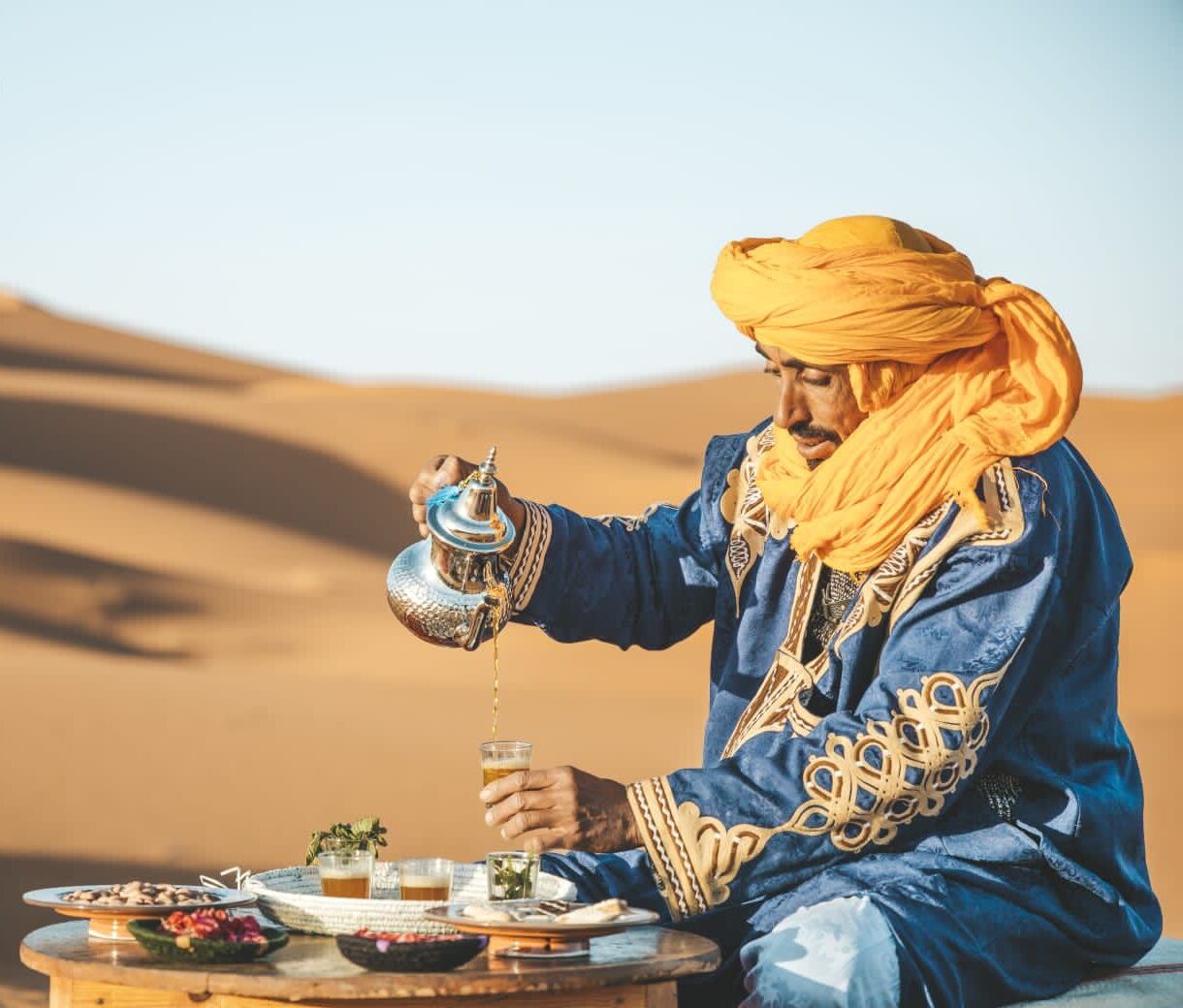
As the sun moves westward and the heat begins to ease, you emerge for tea (usually mint tea, served in the characteristic glasses with fresh herbs from the camp's supplies) and conversation. The light begins its transformation toward the magical golden hour.
Around 4:30 or 5:00 PM, depending on the season, the climb begins for sunset. A camel trek or walk up the dunes to a prime viewpoint becomes the natural activity. You're positioned to watch the light show unfold.
Evening (6:00 PM onwards)
Sunset at Erg Chebbi when you're actually on the dunes is genuinely extraordinary. The colors shift rapidly—orange, red, pink, purple, indigo. Within 20 minutes of sunset, night falls completely. The transition is dramatic.
Dinner is typically a communal affair—traditional Berber tajine, fresh bread, salads, and shared dishes. Around the fire after dinner, there might be music (traditional instruments or drums), conversation, or stargazing. The sky at Erg Chebbi, far from light pollution, offers visibility that city dwellers rarely experience.
Night (8:00 PM onwards)
By 8:00 or 9:00 PM, most guests retire to their tents. The desert night is genuinely quiet in a way that's become rare in the modern world. Many people report sleeping more deeply here than they do at home.
Planning Your Merzouga Erg Chebbi Camp Experience
Now that we've established why location matters, here's how to ensure you're choosing the right camp for your needs.
Verify the Actual Location
When researching camps, don't rely on marketing descriptions alone. Ask specific questions:
- Is the camp at the base of Erg Chebbi, or in the town of Merzouga?
- Can you walk out of your accommodation and be on dune slopes within 5 minutes?
- Do you need motorized transport to reach dunes, or is it walking distance?
- What exactly is surrounding the camp—other structures, or open desert?
Consider Your Priorities
Different travelers want different things. If your priority is authentic desert immersion, a dune-based camp like Original Desert Camp is non-negotiable. If you're primarily interested in the cultural experience of Merzouga town and want desert as a day activity, a town-based camp might suffice.
Be honest with yourself about what you're seeking. Don't compromise on the essential element of your desired experience.
Evaluate Accommodation Types
Dune-based camps typically offer various accommodation options:
- Luxury tents: Spacious, with comfortable beds, good ventilation, and often private bathrooms
- Traditional Berber tents: More basic, but more authentically historical
- Mixed arrangements: Some camps offer both for different budgets
Original Desert Camp's accommodation balances authenticity with genuine comfort—you're in a tent in the desert, but you're not sacrificing basic comfort.
Assess Practical Facilities
Important questions about camp infrastructure:
- Is there reliable water (especially important in the desert)?
- What about sanitation facilities?
- How is the food handled (are ingredients fresh, are dietary restrictions accommodated)?
- Is there heating for winter months (propane heaters or blankets)?
- What communication is available (satellite phone, radio)?
The Broader Context: Why
the Location Matters
Merzouga isn't just a random spot in the Sahara—it's strategically positioned near some of Morocco's most remarkable natural features. The massive Erg Chebbi dunes reach heights of 150 meters, creating dramatic landscapes that shift with the light throughout the day. Choosing a camp here means you're in one of the Sahara's most photogenic and accessible regions, yet still genuinely remote.
The proximity to other attractions also matters. From Merzouga, you can visit the underground lake at Gara Sofla, explore the fossil-rich Erfoud region, or trek through the palm groves of the Draa Valley. A well-positioned camp serves as your base for deeper desert exploration without requiring additional transportation logistics.
Trust Your Instincts About the Camp Operator
Finally, the quality of your experience depends significantly on the people running the camp. Look for operators who:
- Respond promptly and thoroughly to your pre-arrival questions
- Show genuine knowledge about the desert and Berber culture (not generic tourism scripts)
- Demonstrate environmental consciousness and respect for local communities
- Offer flexibility and personalization rather than rigid itineraries
Original Desert Camp prioritizes these elements, ensuring that your stay isn't just a transaction but a meaningful exchange between traveler and host.
Final Thoughts
Choosing the right desert camp in Merzouga requires balancing authenticity with comfort, adventure with practicality, and romance with reality. The best camp for you is one that honestly aligns with your expectations, priorities, and travel style. By asking the right questions before you book, you'll arrive in the Sahara already confident that you've made the right choice—leaving you free to simply enjoy the profound beauty and silence of the desert itself.